The Voyage
James Cameron's relationship with the ocean is a thirty-year project. He has dived more than 30 times to the wreck of RMS Titanic (in support of his 1997 film and in the years before and after), filmed the German battleship Bismarck on the seabed, and led ROV expeditions on the wrecks of HMHS Britannic and the Yongala. In 2012 he completed the first solo descent to Challenger Deep — the deepest point on the planet, 10,908 metres down — in a submersible he co-designed himself, the Deepsea Challenger. He is currently a founding partner and director of OceanX with Ray Dalio.
The Stewardship
Cameron has been an unrelenting public advocate for ocean conservation, deep-sea biology and climate-driven ocean change. The samples collected during the Deepsea Challenger expedition produced several new species descriptions and the first observations of life at full-ocean-depth. Cameron donated the submersible to the Woods Hole Oceanographic Institution to be cannibalised for parts used in subsequent deep-sea research. He sits on the National Geographic Society's board and uses his filmmaking platform — most recently Avatar: The Way of Water (2022) — to make ocean systems legible to billion-strong audiences.
The Vessels
Deepsea Challenger (DSV, 7.3 m vertical-torpedo, 2012) — the only solo full-ocean-depth submersible ever built and operated. OceanXplorer (87 m, with OceanX). Mir-1 and Mir-2 (Russian deep-submergence vehicles he used for Titanic 1995 and Bismarck 2002).
Why this voice on Wind Voyage
Cameron's entire body of work — Titanic, The Abyss, Avatar — is an argument that the ocean is the most cinematic and least understood place on the planet. Wind Voyage is a vessel built for owners who feel exactly that and want to spend serious time there.
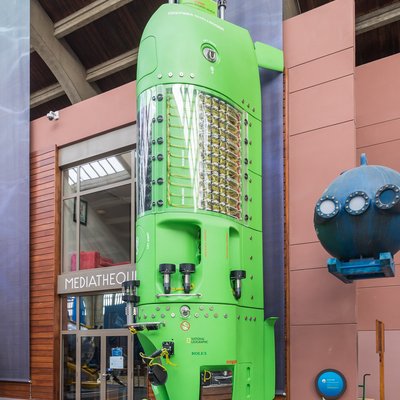 Deepsea Challenger